Monday, October 14, 2013
Relive History in the Dark: Flashlight Tours of Johnston House
Did you ever wonder what it was like to live before electric lights? How did people find their way around after dark? Do you enjoy the occasional, short-term bout without electricity? Do you like to "rough it"? Well, if you’d like to see the 1822 Johnston House by moonlight and flashlight, join the Geneva Historical Society on Saturday, October 19 for a special flashlight tour of the house.
Built by Scottish immigrants John and Margaret Johnston in 1822, the Johnston House originally sat on an important farm where John Johnston became well known for advocating better farming techniques. The Geneva Historical Society will offer a special family-friendly tour of the house from 6:30-8:30 p.m. Tours will start about every 20 minutes, beginning at 6:30 p.m. There will be light refreshments available following the tour. The tour costs $5 per household. The program goes on regardless of weather, so dress appropriately. Bring your flashlight and relive history in the dark!
The Johnston House is located at 3523 East Lake Road, near Route 96A. For more information about this program, call the Geneva Historical Society at 315-789-5151.
Thursday, October 10, 2013
The Louisa May Alcott of Geneva: Sarah H. Bradford
By Kerry Lippincott, Executive Director
For me one of the real pleasures in life is curling up with a good book. Even better is “discovering” a new author. Among the local authors I’ve “discovered” is Sarah H. Bradford. Though Sarah wrote books, short stories, poetry, songs and articles, she is perhaps best known for writing the first biography of Harriet Tubman.
The youngest of seven children, Sarah Hopkins was born on August 20, 1818 in Moscow, New York. Before coming to Geneva in the early 1830s, Sarah and her family lived in Mount Morris and Albany. On May 18, 1839 Sarah married lawyer John Bradford (1813-1861). The couple would eventually settle in a house on South Main Street and raise six children (Charles, William, Mary, John, Elizabeth, and Louisa).
In 1847 Sarah published her first story, “Amy, the Glass Blower’s Daughter.” Though she would write both fiction and non-fiction, Sarah’s primary audience was children. Often written under the pen name Cousin Cicely, her children’s books were considered “Sunday school” books because they offered moral instruction. Perhaps Sarah’s most successful children’s book was the Silver Lake series. Written between 1852 and 1854, the series is a six volume set and each stand alone volume contains a collection a poems and short stories. The Silver Lake series include The Budget, The Jumble, Ups and Downs, The Green Sachel, The Cornucopia and Aunt Patty’s Mirror.
Sarah’s other children’s books include Lewie, or the Bended Twig; The Linton Family, or the Fashion of the World; Getting Well: Tales for Little Convalescents; Grandmama’s Search or Tom Lost and Found; The Old Portfolio; The Dominie or Reminiscences of a Girl’s Life; Splendors and Miseries: A Life of Sir Sacheverill Stiwell; The History of Peter the Great; The Story of Columbus, Simplified for the Young Folks; and The Chosen People.
Sarah’s writings may have helped to support her family as her husband apparently abandoned the family in 1857 and established a law practice in Chicago. After John’s death in 1861 Sarah opened Mrs. Bradford’s School for Young Ladies and Little Girls in her home. Based on an advertisement, the school offered lessons in English branches and Mathematics (for an additional fees piano and ancient and modern language lessons were also offered) over three terms from September 1 to June 1.
![]() |
| Bradford Family Home (629 South Main Street) |
While operating her school Sarah wrote the first history of Geneva, which appeared in the 1862 and 1863 Brigham’s Geneva, Seneca Falls and Waterloo Directory and Business Advertiser. In the late 1860s Sarah was also approached by friends and supporters of Harriet Tubman and was asked to write Tubman’s biography. At the time Harriet Tubman was endanger of losing her home in Auburn. A committee was established to find an author to write her biography. Once published, the biography was to be sold by subscription with the proceeds going to Harriet. Sarah’s interviews with Harriet served as the basis for Scenes in the Life of Harriet Tubman (1869). Sarah, however, is criticized by modern biographers for her artistic lesson and very subjective point of view. A second edition of the book, Harriet, Moses of Her People was published in 1886. Proceeds from the second edition went to the Tubman House, a nursing home in Auburn established by Harriet Tubman for African Americans.
Shortly after the publication of Scenes in the Life of Harriet Tubman, Sarah closed her school and spent eight years traveling around Europe with her daughters. Upon her return to the United States, Sarah lived in Albany and Rochester. On June 25, 1913 Sarah died in Rochester and she is buried in the Washington Street Cemetery.
Friday, September 27, 2013
Diphtheria Epidemic
By Anne Dealy, Director of Education and Public Information
"Diphtheria prevails to no
little extent in Geneva ,
although there have been but few fatal cases." This brief notice in the October 4, 1878 Geneva Gazette marks the first mention of what would come to be one
of the worst epidemics in the community's history. By April 1879 at least 75
people, mostly children, lost their lives. Over 400 of the village's residents
fell ill with the disease between September and March 1879. Whole families
became sick, and a few parents lost all of their children to the disease. Some
people had relatively mild cases, but others had the particularly frightening
"membraneous" type, in which a thick gray substance formed over the
throat causing the victim to gasp and choke when breathing.
![]() |
| Window in St. Peter’s Episcopal Church tower dedicated to the ten members of the Sunday School class who died in the diphtheria epidemic. |
Most
Americans today have no experience with this disease, which has been largely
eliminated in the west due to vaccination. Symptoms include a sore throat,
fever, chills and swollen glands. The illness itself is not deadly, but the
diphtheria bacteria can produce a deadly toxin that causes heart damage, nerve
damage, paralysis, and lung infection. It is one of many ailments that is
particularly devastating to children, but can kill anyone, even those who have
had it before.
Aside
from dealing with the fear that normally accompanies a disease epidemic,
Genevans in 1878 also had no understanding of the cause of diphtheria, nor any
real defense against it. The scientific revolution in medicine was just
beginning in Europe , and medicine was not yet
synonymous with science. Particularly in the United States , there were almost no
standards for medical education, nor were there standards for diagnosing
disease. Any sore throat could be labeled diphtheria, particularly by an
inexperienced doctor. Doctors were free to follow any treatments they believed
worked, and they relied on personal observation and experience, rather than
evidence, to diagnose and treat illness. As a result, theories of disease
causation and treatment varied from the reasonable to the ridiculous.
![]() |
| Some believed open drains, dirt roads and streets strewn with manure caused the 1878 diphtheria epidemic. |
One
popular theory circulating in the late 19th-century posited that sewage and
filth caused disease. "Filth" could refer to human and animal
excrement, trash, swampy land, or rotting plant or vegetable matter.
Recognition that water supplies were connected to the spread of diseases like
typhoid and cholera led people to conclude that many other ailments resulted
from water and air contaminants. One headline in the Geneva Gazette during the epidemic read "Malarial Disease and
Its Remedy." The article went on to decry that "Geneva
is deplorably defective in sewerage. Without it many people have been
accustomed to drain into several little open streams which have their outlets
into the lake and canal." The newspapers were full of letters and
editorials on the danger of open drains and piles of dead leaves, and the need
for a sanitary sewer and safe water system. A sewer system might have prevented
waterborne diseases, but would have done nothing to stop the spread of
diphtheria, which is transmitted by airborne secretions or contaminated items,
like utensils or clothing.
![]() |
| The boards leading from |
There
was some recognition that the disease could be passed from one person to
another, but there was no quarantine in effect. By late October, the village
Board of Health made several regulations to try to control the spread of the
disease, declaring that "The body of
every person who has died of diphtheria or scarlet fever, shall be immediately
enclosed in an air-tight coffin..." and "No person shall enter any house where there is a case of
diphtheria or scarlet fever, unless invited for the purpose of assistance...and
no visit shall be made after death..." It did not help that many
victims had mild infections, and people assumed the mild form was not as
communicable as the "malignant" form. In all likelihood, this
difference in severity was not due to the infection itself, but whether or not
the diphtheria bacteria had produced its deadly toxin.
Druggist
E. Maynard in a mid-November article advocated
"the unceasing use of disinfectants
in the sick-room and in every room adjoining, and every vessel, slop-jar, etc.,
etc. that shall contain any secretion of the sick." He went on to
recommend burying all clothing or bed clothes that came in contact with
discharges from the patient's mouth and washing clothes in carbolic acid. These
precautions probably did help prevent transmission of the disease. On the other
hand, the next article advocated gargling with kerosene oil as a cure. Many
people recognized their helplessness in the face of this disease, "confess[ing] that when [diphtheria]
advances to a certain stage, poisoning the blood in the arteries and veins, a
cure is impossible."
![]() |
| List of Deaths, |
Among
the dead were dry goods merchant George Seelye and his only two children. His
wife survived. Civil War veteran Dr. Calvin H. Carpenter, while treating
patients with the disease, watched it take his own 11-year old son before he
himself fell ill. The doctor's brother then died of it. Three other village
doctors also saw their children die. African-American Charles Gates lost his
6-year old daughter Lena May. Machinist Mathew
Easterbrook died at 54 years old. Several Hobart
students fell ill and the college closed for two weeks. One went home to Syracuse to die there. A
sales agent for the Geneva Courier
who had just moved from Bellona fled back there with his children, only to
watch them both die.
![]() |
| Matthew Easterbrook. |
Then
in December new cases slowed. From 10-15 deaths a week, losses fell to two or
three, then one or two a month. People had no explanation and turned to
religion for consolation. Said one mother, "I was distracted when my Bessie went but now I am calm. Bessie and
Gracie are together, and safe, safe from every danger."
The
village began to examine the cost and methods of creating a sanitary water and
sewer system, but the cost was high and many did not think it worthwhile. Over
the next decade village voters rejected plans to fund a sewer system multiple
times. The community continued to use Castle Creek as an open drain and
deposited sewage in Seneca Lake . It would be
more than twenty years until the city created a sewer system--about the same
time the diphtheria bacteria was identified and an
anti-toxin and vaccine were developed, finally preventing the countless deaths
caused by the disease.
For more information -
Tuesday, September 24, 2013
Neither shall there by any more pain
By Alice Askins, Site Manager at Rose Hill
My Dear
Margaret
. . .
Caroline is now doing very well & has one of the prettiest little girls I
ever saw. . . [she] had a better time than usual[,] she took the Ether &
did not know when the child was born.”
Mary
Saidler Swan to her daughter-in-law, Margaret Swan
The quest to eliminate pain goes back at least to
3,000 years BCE. Early cultures used
various preparations, including alcohol, opium, and cannabis to relieve pain. The first documented use of general
anesthesia during surgery was performed by the Japanese doctor Hanaoka
Seishu. Trained in both Chinese herbal
medicine and Western surgical techniques, Dr. Hanaoka worked for years to
develop a compound of plant extracts that would numb pain and cause temporary
unconsciousness. His first recorded
operation using his formula took place in October 1804, when he performed a
partial mastectomy for breast cancer on a woman named Kan Aiya. Because the government of Japan kept the country isolated from
the rest of the world, Dr. Hanaoka’s achievements were not known in the larger
world during his lifetime. By the time the isolation ended in 1854,
different techniques for general anesthesia had already been independently
developed in America and Europe .
![]() |
| Dr. Hanaoka Seishu |
By the late 1830s, Western doctors and scientists
had experimented with such compounds as nitrous oxide, ether, and
chloroform. The interest at that time
was in the altered consciousness the compounds caused. Traveling lecturers would hold public
gatherings called “ether frolics,” where members of the audience inhaled ether
or nitrous oxide to demonstrate their mind-altering qualities and entertain the
onlookers. Several men who participated
in these events later used these substances as medical anesthesia.
Dr. Crawford Long practiced in Jefferson , Georgia . As a student the University of Pennsylvania ,
he attended ether frolics. Long noted
that some participants experienced bumps and bruises, but afterward had no
memory of the injuries. In March 1842,
he gave ether to James Venable, in order to remove a tumor from the man's neck. In December 1845, Long first used ether as an
anesthetic during childbirth. The
patient’s name seems not to have been recorded.
Because Dr. Long wanted to test ether in many patients over time, before
publishing his findings, he did not at first receive credit for his pioneering
work. There was, in fact, considerable
controversy about who first used ether for anesthesia, but now Dr. Long’s work
is being recognized.
![]() |
| Dr. Crawford Long |
We do know the names of two women who became
well-known for using anesthesia in childbirth.
Frances “Fanny” Appleton Longfellow, wife of the poet Henry Wadsworth
Longfellow, bore six children. When her third
child was born on April 7, 1847, Dr. Nathan Cooley Keep administered ether to
her. She later wrote,
I did it for the good of women everywhere as no
woman should have to suffer that much pain. I am very sorry you all thought me
so rash and naughty in trying the ether. Henry's faith gave me courage and I
had heard such a thing had succeeded in abroad where the surgeons extend this
great blessing more boldly and universally than our timid doctors.... This
is certainly the greatest blessing of this age.
![]() |
| Fanny Longfellow with her sons |
Emma
Darwin, the wife of naturalist Charles Darwin, also tried anesthesia. Darwin
gave chloroform to his wife for the last two of her eight births. The first
time she used chloroform was also in 1847, and for the next (and final) birth
she is said to have screamed, “Get me the
chloroform.”
Historians
debate whether conservative clergymen objected to obstetric anesthesia on
Biblical grounds. In Scotland , Sir James Young Simpson, who advocated chloroform and painless delivery, faced
objections from certain Calvinists, who cited Genesis 3:16: "Unto the woman he said, 'I will greatly
multiply thy sorrow and thy conception; in sorrow thou shalt bring forth
children.'” Opponents interpreted
this passage to mean that God wanted women to suffer in childbirth. It seems, though, that
religious opposition to anesthesia was from a vocal minority. There were also many doctors who were
understandably cautious about anesthesia, because it could present dangers to
mother and child.
There was
a third woman who used anesthesia for childbirth, and she was famous before the
issue arose. Queen Victoria ’s eighth child
was born in 1853, with his mother under an accurate and controlled dose of
chloroform. She reported, "Dr. Snow gave that blessed chloroform and
the effect was soothing, quieting and delightful beyond measure.” Her example broke down barriers against the
practice. In fact, though, as Dr. Simpson said,
Medical men may oppose
for a time the superinduction of anaesthesia in parturition, but they will
oppose it in vain; for certainly our patients themselves will force use of it
upon the profession. The whole question is, even now, one merely of time.
![]() |
| Queen Victoria, Prince Albert and their children, 1857 |
Caroline
Post Swan (Margaret Swan’s sister-in-law) tried “the ether” in 1851, before
even Queen Victoria . We might consider her a pioneer as well.
Friday, September 20, 2013
Doing Research
By John Marks, Curator of
Collections
In June, I wrote about
writing exhibits. I probably should have written this blog first, about
researching for exhibits. However, it came to mind this month as I’m teaching
Public History: The Theory and Practice of Making History Relevant at Hobart and William
Smith Colleges .
Teaching something that you’ve done automatically for many years forces you
stop and think about the activity more closely.
Kerry Lippincott, our
director, asked me to develop a display on Prohibition in Geneva for November’s Geneva Night Out. It’s
a pretty general subject with a definite deadline. We agreed this would be a
good project for college students to work on. I wrote up an assignment and gave
them a list of suggested topics. Each student will do a short product on a
specific part of “Prohibition in Geneva .”
Almost immediately, I
began hearing, “I can’t find anything on my topic.” I think some students see
assignments as tests or as artificial exercises – “the professor knows the
answers, I’m just going through the motions to get a grade.” I tell my class,
“This is not a drill. This is how my job goes – we pick a topic, we’re not
entirely sure what we’ll find on it.”
Some basic tenets of doing
research are:
·
If you’re unfamiliar with a subject, start with general information
and work toward specifics. Wikipedia and online research is fine for starters.
·
Think about the challenges of the subject. Was it illegal
or a cultural taboo? If so, people probably didn’t write about it, take
photographs, or leave us other historical evidence
·
Think about language. People develop code words and slang
for things, like illegal drinking or drug use, that can’t be discussed openly.
Language changes; slang for drinking or intoxication may have been different in
the 1920s, so you need to know what to look for.
·
People may be more open about illegal activities decades
after the fact. Newspapers in the 1920s may not have much information, but
articles from the 1960s or later – long after Prohibition was repealed – may
have first-person stories about bootlegging in Geneva .
·
There are no dead ends. If you’ve truly looked everywhere
and tried different search terms, then absence of information means something. Why
wasn’t something in the newspaper? Was it so taken for granted that it wasn’t
newsworthy? (Aside from huge events, newspapers don’t consciously record
history – they sell papers). Was it taboo? Did the publisher/ owner of the
paper disagree with something and didn’t want to report it? You shouldn’t jump
to conclusions, but come up with more research questions to figure out the
absence.
·
Finally, document everything, including the not-dead-ends.
It is easy to forget what research you’ve done, particularly on big projects,
so leave yourself a paper trail. In the case of academic assignments, an
extensive paper trail may prove to your professor that you really did look everywhere.
“Prohibition in Geneva” will open November 1 for Geneva Night Out, 5-8 pm.
Friday, September 13, 2013
Crafts Then and Now: Godey's Ladies Book
By Karen Osburn, Archivist
Many
of my friends are artists and “crafters”, people who create beautiful jewelry,
furniture, clothing, housewares, musical instruments and more with their hands. Through knowing these talented folks a bit of
their interests have rubbed off on me and over the years I have tried my hand
at a wide variety of crafts including macramé, embroidery, crochet, sketching,
sewing and beadwork to name a few. I
find learning new crafts exciting and fun.
Apparently so did women in the 19th century.
In
the Historical Society Library and Archives we have copies of Godey’s Lady’s Book and Magazine dating
from 1858 to 1870 and Peterson’s
magazine from 1863 to 1877. They show
many examples of handwork for women. Godey’s
had a section called “Work Department” and other areas called Novelties,
Embroidery and Fashions. Each of these
sections of the magazine had ideas, patterns or suggestions of items to be
stitched, altered, crocheted, tatted, embroidered or created by hand. The archive also has a copy of Catharine E.
Beecher and Harriet Beecher Stowe’s The
American Woman’s Home which devotes an entire chapter to “Home
Decoration”. Many of the projects in
these publications are suggested as a way to make something useful expending as
little money as possible. This seems to
have been a common thread in many ladies publications of the 19th
Century.
It
appears that in the past, women of financially stable families were encouraged
to do handwork. In the Historical
Society collection we have several samplers by different individuals testifying
to proficiency with a needle. Information
gathered from Geneva
newspapers, such as the Geneva Gazette of
November 1, 1809, which gives notice of a school for girls opening in the
instructor’s home that will be for the purpose of “the instruction of Females, in the various branches of
usful [sic] and ornamental education-”.
A similar newspaper notice in the Gazette
from August 31, 1814 announces, “Geneva
Academy , The public are
informed that this Academy is now open for the reception of Students. The Trustees have employed Mr. Ransom Hubbel,
as Principal; Mr. Moses Young, and Mrs. S. Mizner as Assistants- all of them
experienced and weil [sic] recommended Teachers. The various branches of Classical and Common
Literature, together with plain, and fine Needlework, Painting, Drawing,
&c. are taught in this institution, on reasonable terms. .....”
and one in 1823 that states, “Advertisement for Mrs. Plumb's Female
Boarding School- Teaching feminine arts. Includes costs.” Women were often considered too delicate to
acquire an education in mathematics, science or languages like Greek or
Latin. They were guided toward music,
art, painting, drawing and sketching, literature and needlework. In part because of this, magazines like Godey’s became popular since they came
with patterns, instructions and pictures as well as stories and advice.
Some
of the items promoted in magazines were as fun and interesting to create then as
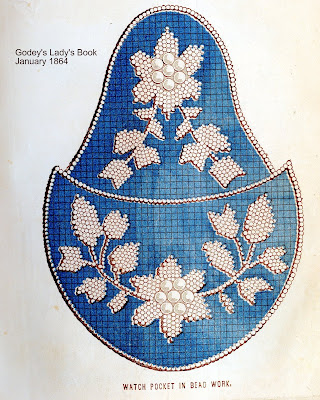
it now. In the Godey’s Ladies book of February 1864, vol. LXVIII there is a
pattern for a beaded watch pocket. I had
the privilege of working with Native American beadwork collections housed at
the Rochester Museum
& Science Center
and the Royal Ontario
Museum in Toronto and one of the pieces I saw was a
beaded watch pocket. In the 19th
century many Native Americans made beadwork pieces to sell to tourists and the
items were popular enough that patterns were printed in women’s magazines so American
women could try their hand at them. Of
course this opens room for a discussion as to which came first, Native American
bead goods that encouraged women to imitate their product, or a desire for a
certain type of product on the part of tourists that caused the indigenous
people to create items that catered to that taste? I don’t know the answer, but I do know that
both Native American women, many times from Iroquoian language based groups,
did some beautiful beadwork purses, pockets, pincushions, card cases and more,
as did other women who had the leisure time to do this type of handwork. The colors, patterns and varieties are varied
and lovely.
What
types of items did women create in the 1800s?
We have examples of clothing, embroidery, samplers, feather wreathes,
hair jewelry, and hand painted items in the Geneva Historical Society
collection. Some crafts like drawing,
painting and crochet continue to be of interest through time. Other ideas, such as hair wreaths, are seldom
created anymore.
All
the women I grew up with did handwork.
My grandmother was capable of looking at a crocheted doily on a
neighbor’s table and reproducing it without instructions. She also did embroidery that was just
beautiful. My mother was a very capable sketch artist as well as good at sewing
clothes, embroidery, wood carving and crochet.
My sister is good at all those things plus makes incredibly decorated
walking sticks. I also have male friends
who have made musical instruments, their own chainmail shirts, carved with
chain saws, and made furniture. Crafts
and art are an equal opportunity form of expression.
Perhaps
you have a favorite hobby? You may want
to look in old books and magazines to find new/old patterns to embroider or
crochet; new techniques to try with painting or even a new/old hobby such as
stenciling. There are many satisfying
and intriguing historic crafts just waiting to be rediscovered. I hope this piques your interest enough to
investigate your talents.
Saturday, September 7, 2013
Pierce and Bickford
By Kerry Lippincott, Executive Director
There are many subjects that I consider myself fairly knowledgeable about, but architecture is not one of them. Like art, I like what I like. However, while working for the Chemung County Historical Society in Elmira I couldn't help but learn a thing or two about the architectural firm of Pierce and Bickford. The firm built a variety of structures in and around Elmira, including Elmira City Hall, F.M. Howell and Co. building, Hedding Methodist Church and several private homes. To my surprise, I've discovered that Pierce and Bickford have a connection to Geneva. In the early 1890s, they built and designed the YMCA building (76-86 Castle Street) and the Smith Opera House.
Born in Dundee, Joesph H. Pierce (1855-1932) came to Elimira to study under the architect Eugene B. Gregory. Within a year Pierce was working for William H. Hayes (the first graduate of Cornell's architecture program). Between 1883 and 1890, Pierce had a partnership with engineer Otis Dockstader. Though the firm of Pierce and Dockstader constructed a variety of buildings, they specialized in residential homes and churches. In 1890 Hiriam H. Bickford (1863-1928) joined the firm as a draftsman. Little is actually known about Bickford. Born in Vermont, Bickford worked for several firms in the Northeast before coming to Elmira.
In 1891 Piece and Bickford formed their own firm. Based out of Elmira, they would design and construct schools, churches, private homes, apartment houses, commerical buildings, hospitals, public buildings and other structures in New York, New Jersey and Pennsylvania. In all Pierce and Bickford built several hundred buildings and designed the renovations of many more. A number of Pierce and Bickford's buildings are on the National Register of Historic Places. These include Dundee Methodist Church, First Baptist Church in Painted Post, Elmira Heights Village Hall, Fire Station No. 4 in Elmira, and the Clifton Springs Sanitarium (the Spa Apartments).
After Bickford's death in 1928 his son Robert (who had served as a draftsman at the firm for several years) became Pierce's partner.
For more information about Pierce and Bickford, read Architects of Standing: Pierce & Bickford Elmira, NY, 1890-1932 by Roger G. Reed.
There are many subjects that I consider myself fairly knowledgeable about, but architecture is not one of them. Like art, I like what I like. However, while working for the Chemung County Historical Society in Elmira I couldn't help but learn a thing or two about the architectural firm of Pierce and Bickford. The firm built a variety of structures in and around Elmira, including Elmira City Hall, F.M. Howell and Co. building, Hedding Methodist Church and several private homes. To my surprise, I've discovered that Pierce and Bickford have a connection to Geneva. In the early 1890s, they built and designed the YMCA building (76-86 Castle Street) and the Smith Opera House.
![]() |
| YMCA Building |
Born in Dundee, Joesph H. Pierce (1855-1932) came to Elimira to study under the architect Eugene B. Gregory. Within a year Pierce was working for William H. Hayes (the first graduate of Cornell's architecture program). Between 1883 and 1890, Pierce had a partnership with engineer Otis Dockstader. Though the firm of Pierce and Dockstader constructed a variety of buildings, they specialized in residential homes and churches. In 1890 Hiriam H. Bickford (1863-1928) joined the firm as a draftsman. Little is actually known about Bickford. Born in Vermont, Bickford worked for several firms in the Northeast before coming to Elmira.
In 1891 Piece and Bickford formed their own firm. Based out of Elmira, they would design and construct schools, churches, private homes, apartment houses, commerical buildings, hospitals, public buildings and other structures in New York, New Jersey and Pennsylvania. In all Pierce and Bickford built several hundred buildings and designed the renovations of many more. A number of Pierce and Bickford's buildings are on the National Register of Historic Places. These include Dundee Methodist Church, First Baptist Church in Painted Post, Elmira Heights Village Hall, Fire Station No. 4 in Elmira, and the Clifton Springs Sanitarium (the Spa Apartments).
After Bickford's death in 1928 his son Robert (who had served as a draftsman at the firm for several years) became Pierce's partner.
For more information about Pierce and Bickford, read Architects of Standing: Pierce & Bickford Elmira, NY, 1890-1932 by Roger G. Reed.
| Smith Opera House |
Subscribe to:
Posts (Atom)


