Showing posts with label Genealogy. Show all posts

Monday, April 8, 2013

So, what does an Archivist really do? (Or Spelunking in the Basement of Doom)


By Karen Osburn, Archivist and City of Geneva Historian


Tip of the ice burg!

I love it when people ask me what an archivist does.  I tell them it is like being a Time Traveler, a Detective and a Treasure Hunter every day.  When I arrive for work, I never know which hat I will have to put on.  It depends on what our patrons research needs are that day.  If I tell people I take care of rare manuscripts, letters, and old photos and papers some folks think I am stuck in a moldy old basement with lots of dusty old files.  (Actually, it is like that some days, but more about that later.)  Really it is much more exciting. 

In my “Sherlock Holmes” role I had the opportunity to reunite a widower with the scrapbooks his beloved wife, now deceased, made early in their married life.  A good Samaritan found the books in an antique market in one of the southern states and felt they were too personal not to be reunited with a family member.  This generous soul purchased the books and brought them to her home in New England and called me to help her find the family of the scrapbooks creator.  I put on my detective hat and began searching for a relative.  I had several volunteers working on the “hunt” with me.  Eventually we located the surviving spouse who was very excited and happy to get the books back.  He had no idea how they got to the Carolinas, but he stated he had missed his wife every day since she had died and he was delighted to get this wonderful reminder of her.  The woman who had rescued the scrapbooks, sent them to him at the senior living facility where he resided.  I had the warm feeling of having made two people very satisfied.

In my role as “Time Traveler” I get to explore old letters and documents that take me back in time and place me on steamships or trains, in parlors and kitchens, at weddings and funerals, in theaters or in stores.  I sit in meetings with Village Trustees when I read the minutes of the discussions held in 1812.  I watch the soldiers enlist and march off with their units in the Civil War.  I once had the privilege of “sitting on the deck of a Seneca Lake steamship in 1849” as a man wrote to his wife about seeing a woman working on a cadaver at the Geneva Medical College who could only have been Elizabeth Blackwell.  Wow! 

Enter the basement of doom at your peril!

The role of Treasure Hunter is really exciting.  Of course I am not talking about gold, silver or diamonds, but the “treasure” of information.  I was recently asked to put on my “Indiana Jones fedora” and go spelunking for artifacts in the basement of an old building.  Grabbing a flashlight I took my first hesitant steps into the dark cellar by walking on a plank (shades of Pirates of the Caribbean), then made my way down some stairs, holding a rickety railing, that ended at a hole in the floor.  Gingerly making my way around the hole I tiptoed carefully through the dust of ages (and crushed bricks) until I stood in a room peering at piles of dusty books.  The floor sparkled where mineral crystals had leached up from the ground.  I had made it safely without encountering rolling boulders, spikes in the floor or hordes of tarantulas!  These books were business ledgers and recorded the history, not only of one business, but many.  They held names and information from well over 100 years ago and many of them were in remarkably good condition.  For a researcher or an archivist this is comparable to finding a gold nugget when you stoop to pick up after your dog, a totally unexpected surprise. 
           
This is what being an archivist is like, each day is a surprise.  Who will be delighted with what you discover today? Will you thrill some small children, please your employer, reunite a researcher with memories, help a person find a lost sibling, solve a family mystery, answer the unanswerable question?  Perhaps you will find a photo for a publisher or locate the famous or infamous in the archive vertical files.   The possibilities are endless.  I have provided images for authors in England and Japan, photos for the sets of television shows, maps for surveying companies, house histories for home buyers, and recipes for grape ketchup to aspiring cooks.  Where else can a person get so much variety in just a couple of hours of work?

Wednesday, January 16, 2013

Will Your History Be A Mystery?

By Karen Osburn, Archivist


What will your grandchildren be able to find out from the historic records you leave behind? I am often asked why I don’t have images of or information on a certain home, building, event, or person in the Historical Society Archives and I tell the questioner it is because no one shared a photo or research material with us.  Most of our collection is made up of items and information donated to the historical society.

Many people think photographs and manuscripts from 20, 30 or 40 years ago are too recent to be of interest to historians, but these items are already historic.  How many people remember businesses like “Cool Beans” located in the Dove Block during the early 2000s or Mario’s located on Hamilton Street ?  These were businesses that existed in Geneva just 10 years ago and are now gone.  Our archive has a small amount of material on each of these restaurants that we actively collected when we knew each establishment was going out of business, but hundreds more everyday events that make up the bulk of history, go uncollected and unrecorded each year.


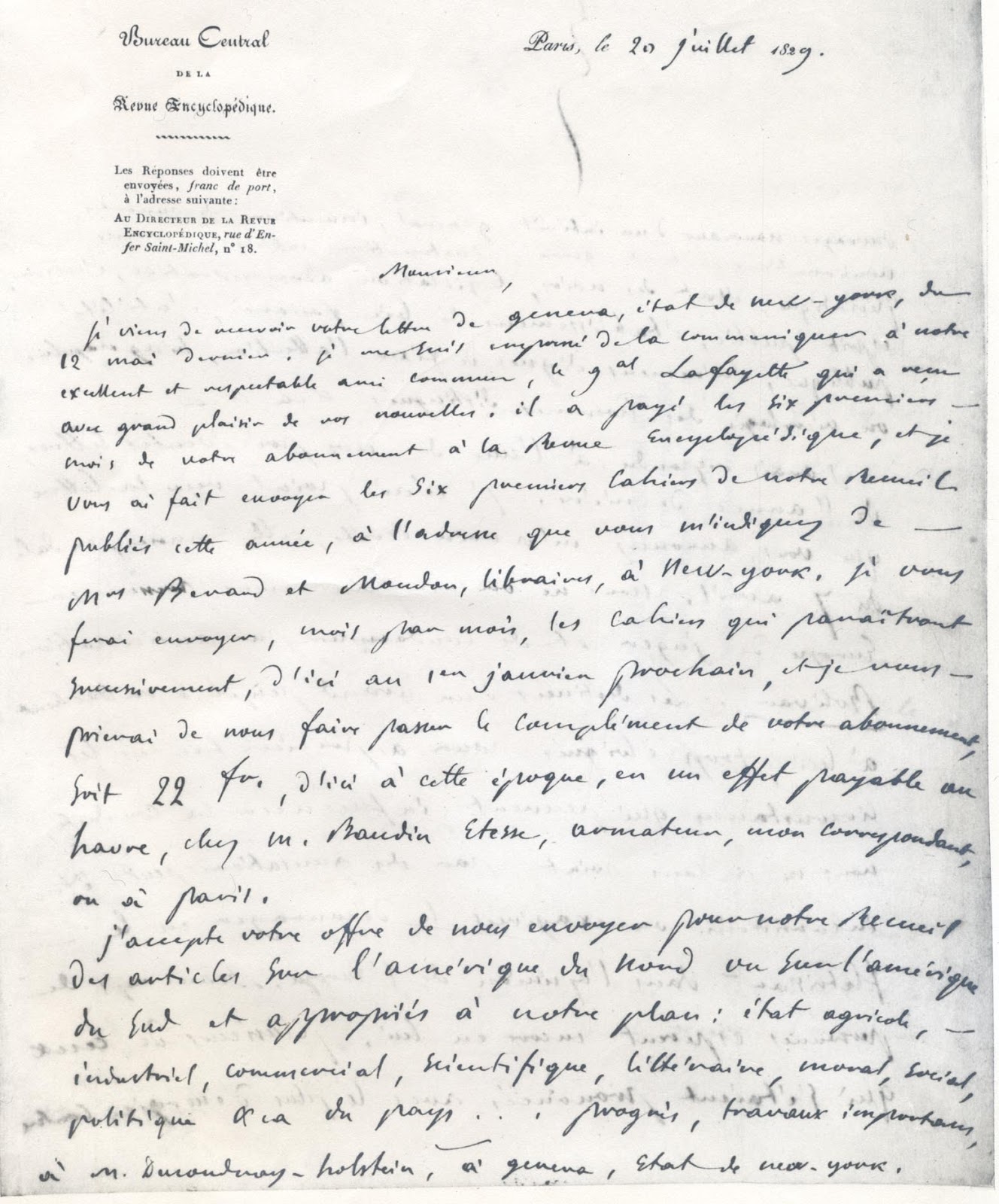
Example of a letter from our collection dated 1829.  
Will there be any documents to tell your story in 184 years? 
How many examples of handwriting will 
actually 
survive 100 years from now? 

 This is a problem and will become a larger problem as time goes on.  In the age of information, people may not save photographs in the same format, may not write letters, may have manuscripts saved in the “cloud”.  There are wonderful new space saving, easy access forms in which to store information, but will your children think to look on your computer and transfer your image files to their computer?  Or, if you saved electronic communications, will your grandchildren find your e-mails to their parents as detailed and interesting as the letter you would have written 20 years ago?  Do you keep journals or diaries on your laptop? Will your unprinted manuscript ever get printed?  Will your nieces and nephews find the images of the old family homestead that you linked to Ancestry.com?  Perhaps, but what happens to the history of your family, the first family home, or the business your grandfather started if they don’t think to look at your electronic records? 

I don’t bring these questions up because I want folks to flock in here with all their records (though I wouldn’t mind that), but because I would like to remind everyone that history is fragile.  No museum or historical society has the staff to continually go out into their city and record every change that happens each year; we rely on our members and the public to help us preserve the story of our area.  If your history, which is entwined with the place you live, is created and preserved on a computer will your heirs think about contributing this information to the local historical society or just wipe the hard drive clean?

A photograph of Hugh Dobbin who died in 1855.
Will there be a photograph of you for your
relatives to see in 158 years?
I have a few suggestions that may help you ensure the future of your past.  If you save your photographs electronically back them up on a flash drive, or external hard drive.  Also make sure you label each photo and each file so people looking at them know who is in the picture, when and where it was taken.  The quickest way to insure photos will not be saved by future generations is to leave a collection of images with no identification.  There will come a time when no one remembers who the people are and the images lose their historic value.

The historical records you leave behind for your family allow you to tell your story to them long after you are gone.  The words and images you preserve for them will bring You to life for generations to come.  A little careful planning on your part can help you ensure your personal history is accessible and preserved for your family.  If you want help or suggestions on record preservation just contact the archivist or curator at your local historical society and discuss it with them.  The steps you take today save history for tomorrow.

Volunteer, Jane Donegan, working on Warren Hunting Smith's papers, 
a collection consisting of over 30 boxes of material.